
Modern portraiture
Vincent van Gogh
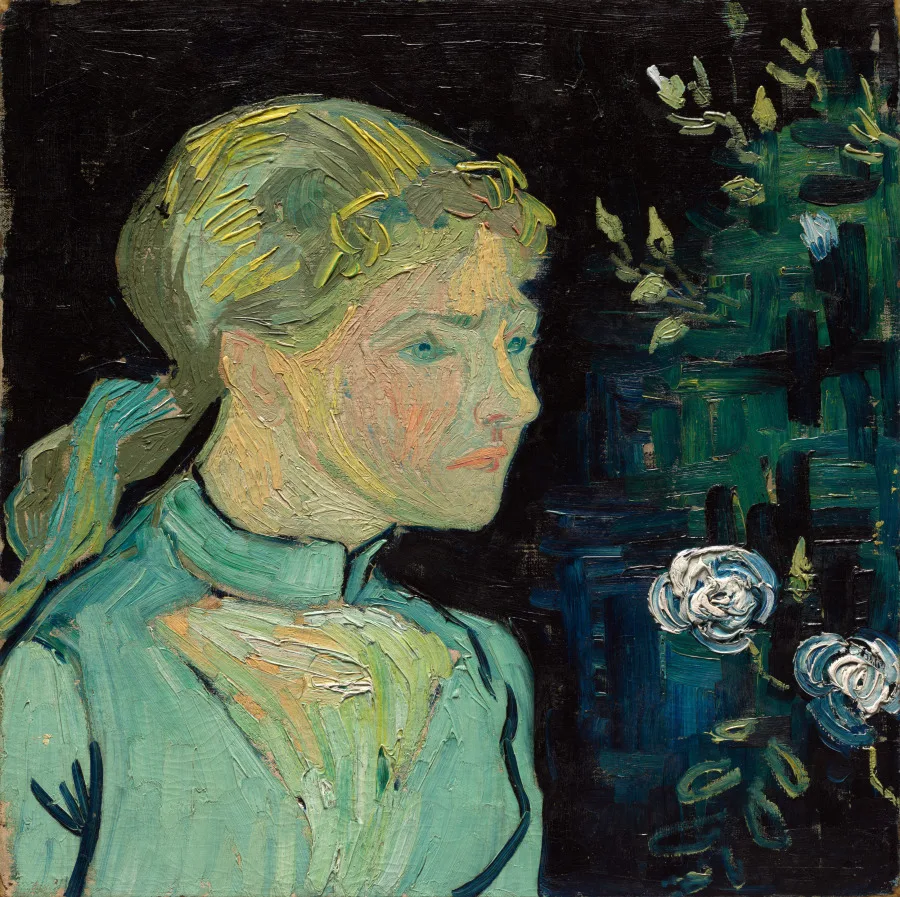
Van Gogh cared about portraits more than about any other subject and struggled to find sitters. The Cleveland canvas shows Adeline Ravoux, the innkeeper daughter at Auvers, painted in the last summer of his life.
Vincent van Gogh started painting seriously in 1880, at twenty seven, after failing as an art dealer, a teacher and a lay preacher in the Belgian coalfields. He had less than a decade of working life ahead of him. The early Dutch years produced dark peasant subjects culminating in the potato eaters of 1885, painted in browns and greens with figures modelled like carved wood.
Paris changed the colour. He moved there in 1886 to live with his brother Theo, met Pissarro, Bernard, Toulouse Lautrec and Gauguin, saw impressionist painting in quantity and studied Japanese prints. Within two years the palette had gone from bitumen brown to full chroma and the brushwork had broken into separate directional strokes. He left for Arles in February 1888 looking for stronger light and cheaper rent.
Why he wanted sitters and rarely got them
The letters are unambiguous about his priorities. He wrote to Theo again and again that portraiture was what he cared about most and what he intended to be remembered for, and that modern portraits should use colour to say something about a person rather than merely record a likeness. The obstacle was practical. He had no money to pay models and few people in a small French town wanted to sit for a foreign painter with his reputation.
So he painted whoever was available: the postman Joseph Roulin and his family, a Zouave soldier, a peasant, the woman who ran a cafe, the asylum attendant at Saint Remy, and himself repeatedly when nobody else would do it. The self portraits are partly a solution to a supply problem. That constraint gave the work its texture, since the people in these canvases are the ones who actually stood near him.
The Cleveland picture shows Adeline Ravoux, the daughter of the innkeeper at Auvers sur Oise where van Gogh lodged in the final months. She was thirteen. He painted her more than once in the summer of 1890, in a blue dress against a blue ground, with the flesh handled in strokes that follow the shape of the cheek and jaw. The colour scheme is deliberate rather than observed, exactly what the letters describe.
- Colour chosen for emotional effect rather than matched to the sitter appearance
- Backgrounds treated as flat coloured fields, often taken from Japanese prints
- Brushstrokes that follow the form of a face like modelling in clay
- Complementary pairs, orange against blue and red against green, driving the design
- Sitters drawn from people who were simply nearby, including the postman and the innkeeper family
- Repeated versions of the same subject painted quickly one after another
He arrived at Auvers in May 1890 after a year in the asylum at Saint Remy, and worked at a pace that is difficult to credit: roughly seventy canvases in about seventy days. The physician Paul Gachet, an amateur painter and etcher himself, kept an eye on him and sat for two portraits. That final burst includes the wheatfields, the church, the town hall and the Ravoux portraits. He died in July.
What the last summer actually contains
The popular account compresses all of this into a story about madness and a single famous ear. The pictures do not support that reading. The Auvers canvases are controlled, structurally inventive and constantly experimenting with format, including the double square landscapes that are unlike anything else painted in the period. Whatever else was happening, the painter was working with complete deliberation.
The Auvers portraits are the closest van Gogh came to the programme he described in his letters: a modern portrait built out of colour rather than out of resemblance.
Editorial note, Canvara
For a viewer standing in front of one, the useful exercise is to ignore the biography for five minutes and follow the brush. Every stroke has a direction that describes a plane, and the background colour is doing structural work rather than filling space. That is a technical achievement, and it is the part of van Gogh that the mythology tends to bury.
Interested in Vincent van Gogh’s work?
Ask a curator for current availability, pricing and how this artist would sit in a collection.
Ask a CuratorBrowse the full Artists Directory.
Or read more in the Journal.
Ask about Vincent van Gogh directly
Availability, current prices, condition, how the work sits in a collection. Leave a number and an editor calls you back within two business days.
This form needs JavaScript. Write to editor@laart.us instead — an editor answers every letter.