
Regency portraiture
Thomas Lawrence
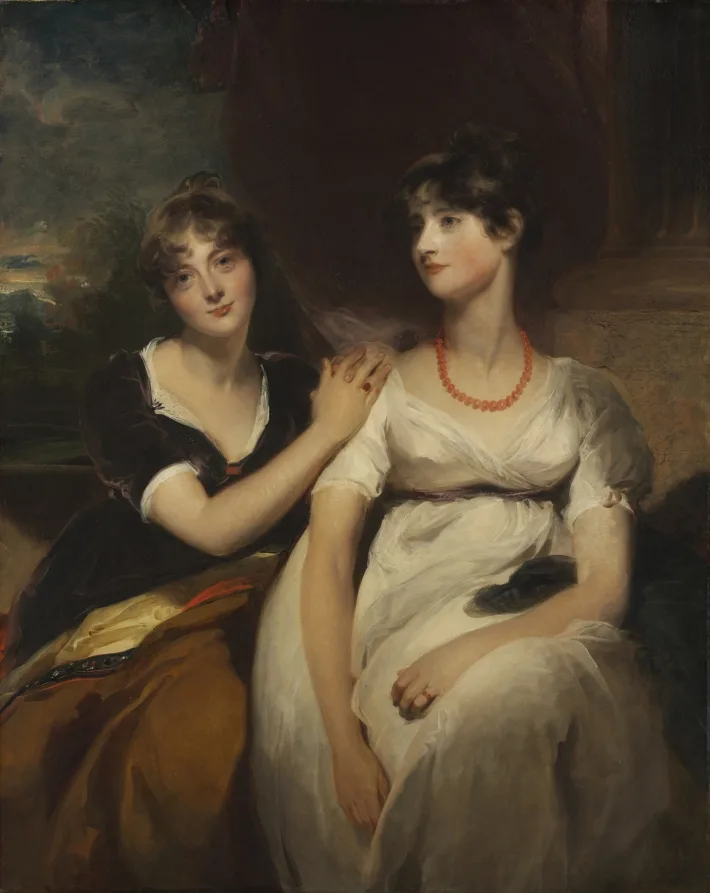
Thomas Lawrence was a self taught prodigy who ended as president of the Royal Academy and portraitist to half the courts of Europe. The Cleveland double portrait of the Carteret Hardy sisters dates from 1801.
Thomas Lawrence was born in Bristol in 1769 and grew up at an inn at Devizes that his father kept on the Bath road. Travellers were shown the boy, who drew their profiles in pencil for a fee. By the age of ten he was earning money for the household with pastel portraits, and there was no apprenticeship, no drawing master and very little schooling behind any of it. The family moved to Bath to work the market properly.
He entered the Royal Academy schools in 1787, exhibited in oils almost immediately and had the town talking within two years. When Reynolds died in 1792 Lawrence was appointed painter in ordinary to the King, at twenty three, over a field of far more experienced candidates. The rise is the fastest in the history of British portraiture and the rest of his life was spent keeping up with the demand it created.
The prodigy and the royal appointment
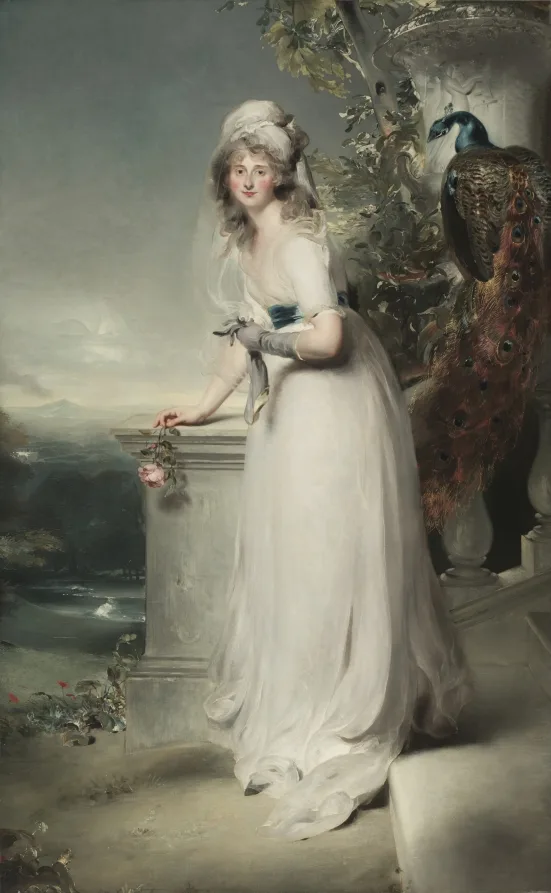
The Cleveland picture of Charlotte and Sarah Carteret Hardy comes from 1801, when the style had fully formed. Lawrence painted with more sparkle than anyone of his generation: wet looking eyes, glossy hair, satin that appears lit from inside and a general sense that the sitter has just turned toward you. He used strong lighting contrasts and a red brown ground that warms the shadows and pushes the flesh forward.
Children and young women brought out his best work, which is not always a compliment in the criticism. The charge against him is that the charm is applied uniformly, so that a bishop and a debutante come out equally luminous. There is something in that. The counter argument is that in his strongest portraits, particularly the men painted after 1815, the sparkle sits on top of very acute drawing of a specific head.
After Waterloo the Prince Regent sent him across Europe to paint the sovereigns, ministers and commanders of the coalition that had defeated Napoleon. Between 1818 and 1820 he worked at Aix la Chapelle, Vienna and Rome, painting the Emperor of Austria, the Pope and a long list of field marshals. The results hang together in the Waterloo Chamber at Windsor Castle and form the most ambitious portrait cycle commissioned in Britain.
- A warm red brown ground that keeps the shadows glowing rather than cold
- Highlights placed in the eyes and on the lower lip to give a look of animation
- Rich blacks and scarlets used for court and military dress
- Fluid, thinly painted backgrounds that leave the figure carrying all the weight
- Superb drawing in chalk, often better evidence of his eye than the finished oils
- A large trade in engravings after his portraits during his own lifetime
He was knighted in 1815 and elected president of the Royal Academy in 1820, holding the post until his death. Money passed through him without stopping. He earned enormous fees, collected old master drawings on a scale that few private collectors have matched, and died in debt in 1830. The drawings collection was offered to the nation, refused and dispersed, which is one of the more painful episodes in British collecting history.
Reputation after the Regency
Victorian taste turned against him fast. The gloss that had looked modern in 1815 read as insincere by the 1860s, and for a century Lawrence sat well below Reynolds and Gainsborough in the standard accounts. Recent scholarship has been kinder, partly because the drawings are unarguable and partly because the Waterloo Chamber portraits look far tougher in person than reproductions suggest.
Lawrence painted the last generation of European sitters who believed a portrait could settle how history would see them, and he gave them exactly the picture they wanted.
Editorial note, Canvara
Anyone looking at Lawrence in a museum should find the chalk drawings if the collection has them. Stripped of the satin and the lighting, the underlying observation is plain and often severe. The oils tell you what the Regency wanted to look like, and the drawings tell you what he actually saw.
Interested in Thomas Lawrence’s work?
Ask a curator for current availability, pricing and how this artist would sit in a collection.
Ask a CuratorBrowse the full Artists Directory.
Or read more in the Journal.
Ask about Thomas Lawrence directly
Availability, current prices, condition, how the work sits in a collection. Leave a number and an editor calls you back within two business days.
This form needs JavaScript. Write to editor@laart.us instead — an editor answers every letter.