
English portraiture
Thomas Gainsborough
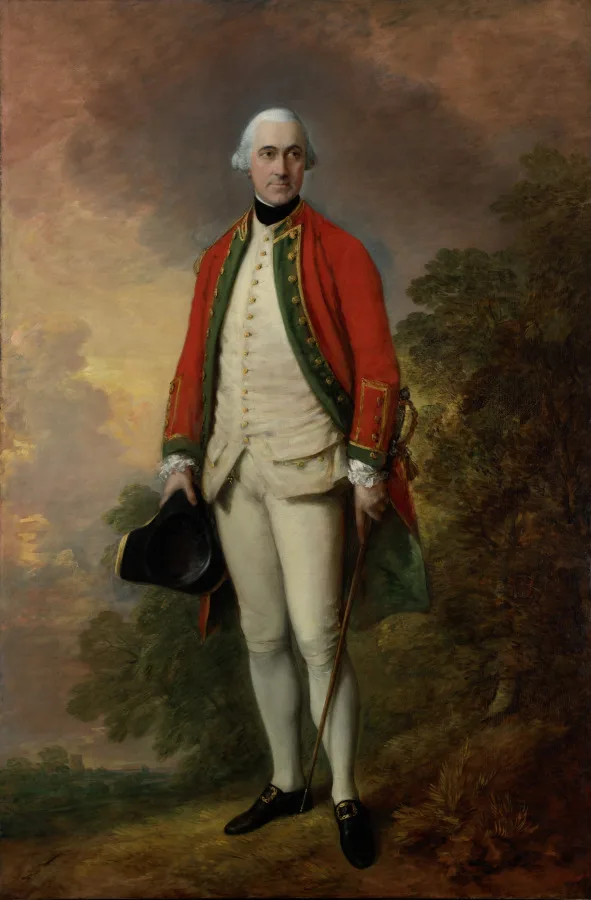
Thomas Gainsborough complained about portrait commissions for most of his life and produced some of the best in British art anyway. The Cleveland portrait of Baron Rivers dates from 1769, the year after the Royal Academy opened.
Thomas Gainsborough was born in Sudbury in Suffolk in 1727 and sent to London as a boy to learn the trade. He worked with the French engraver Hubert Gravelot, absorbed the light rococo manner that came with him, and spent time restoring Dutch landscapes, which mattered more to his development than any formal instruction. He was back in Suffolk by his early twenties, painting small portraits of local families set outdoors in real countryside.
Those early Suffolk pictures are hybrids. The sitters are stiff little figures placed in landscape that is observed, English and specific, and the landscape is plainly what interested the painter. He said as much repeatedly in letters to friends, complaining about faces and wishing he could walk off to a quiet village with his instrument and paint scenery. The complaints continued for the next thirty years while the portrait income paid for everything.
From Suffolk to Bath and the London years
In 1759 he moved to Bath, where the fashionable world came to take the waters and where a portrait painter could charge properly. His prices rose quickly and the format grew: full lengths, silks, elaborate settings. Bath also gave him access to the Wallace and Methuen collections of van Dyck, and the effect is immediate. The figures loosen, the proportions stretch and the handling becomes lighter and faster.
He was a founding member of the Royal Academy in 1768 and moved to London in 1774. Relations with the institution were poor. He argued about how his pictures were hung, withdrew from the exhibitions in 1784 and showed work at his own house in Pall Mall instead. He was not interested in theory, sat on no committees and wrote no lectures, which put him in permanent contrast with Reynolds.
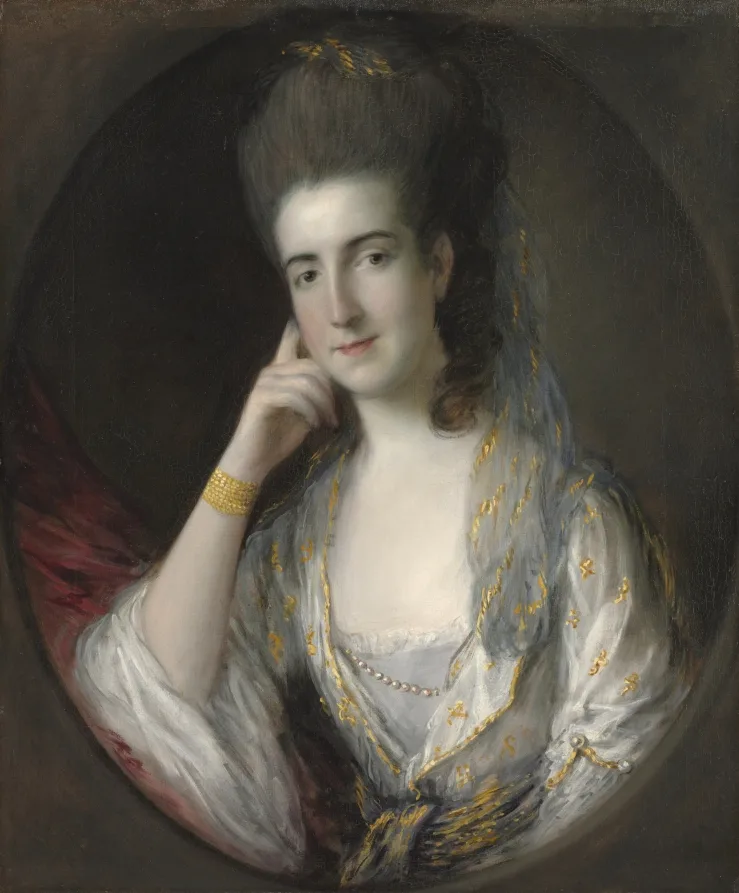
The technique is the thing people notice first and describe worst. He used very long brushes, worked at a distance from the canvas in dim light, and built the picture from thin, dragged strokes that sit lightly on the weave. Nothing is blended in the ordinary sense. Hair, lace and foliage are all made from the same nervous flicking motion, which is why a Gainsborough background and a Gainsborough sleeve look like they belong to one another.
- Long brushes and thin paint dragged over the canvas weave rather than blended into it
- The same flicking stroke used for hair, lace, leaves and grass across the whole picture
- Cool blues and silvery greens repeated through costume and setting
- Figures set into real English countryside rather than into studio backdrops
- Proportions lightly elongated after his study of van Dyck in Bath
- Late landscapes and fancy pictures painted for himself with no client attached
The landscapes he wanted to paint mostly did not sell. He kept making them anyway, and toward the end of his life added the so called fancy pictures of country children, which he seems to have valued above his portrait work. Modern opinion has largely come round to his own view. The portraits pay the rent in the story, but the landscape and the late figure subjects are where his instincts run free.
The rivalry that shaped a market
Reynolds and Gainsborough divided London between them. One offered classical reference, an institutional position and a theory of art. The other offered speed, atmosphere and a touch that nobody could copy. Reynolds devoted his fourteenth Discourse to Gainsborough after his death in 1788, praising the handling while gently regretting the absence of a system. It reads like an admission that the untheorised painter had won something.
Gainsborough is the argument against art theory: he never wrote a programme, disliked the Academy and still produced the most inventive surface in British eighteenth century painting.
Editorial note, Canvara
If you want to see what he does, find a full length and look at the bottom third of the canvas. The skirt, the grass and the shadow under a tree are usually painted in the same handwriting with barely a change of pressure. That unity of touch across figure and setting is the signature, and it survives even in works where the face has been repainted or heavily restored.
Interested in Thomas Gainsborough’s work?
Ask a curator for current availability, pricing and how this artist would sit in a collection.
Ask a CuratorBrowse the full Artists Directory.
Or read more in the Journal.
Ask about Thomas Gainsborough directly
Availability, current prices, condition, how the work sits in a collection. Leave a number and an editor calls you back within two business days.
This form needs JavaScript. Write to editor@laart.us instead — an editor answers every letter.