
Society portraiture
Joshua Reynolds
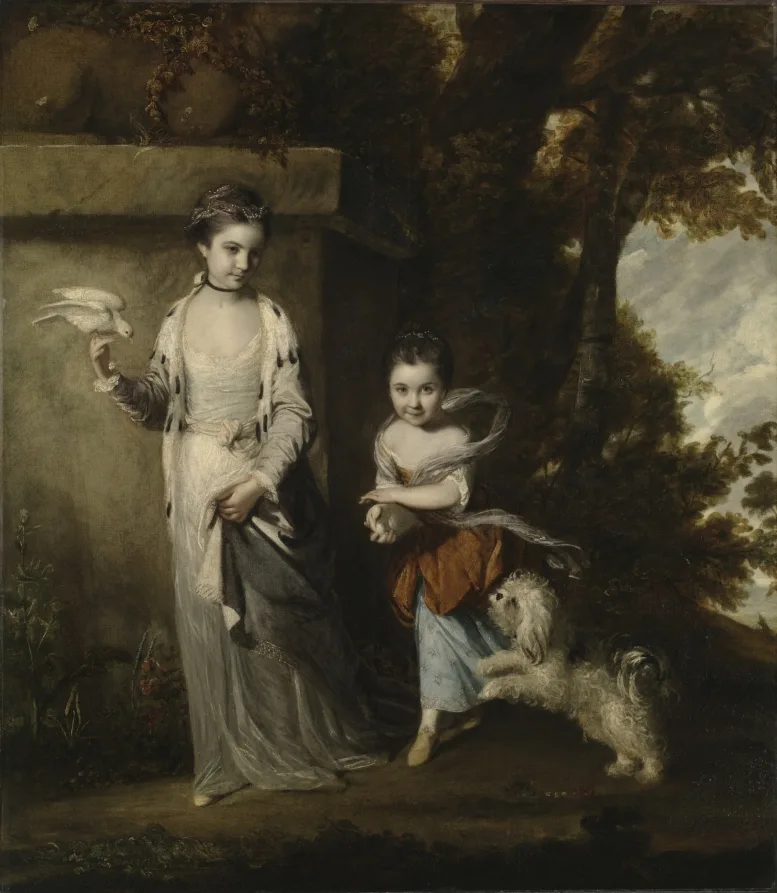
Joshua Reynolds turned portrait painting into an intellectual programme and a large business at the same time. The Cleveland double portrait of the Yorke sisters, painted around 1761, shows the machine at full speed.
Joshua Reynolds was born in Devon in 1723, the son of a schoolmaster, and served an apprenticeship in London with the portraitist Thomas Hudson. That would normally have produced a competent provincial career. What changed the outcome was a voyage to Italy in 1750 and nearly three years spent in Rome, Florence and Venice copying the old masters and thinking hard about what separated a great picture from a good likeness.
He came back with a theory. British portraiture up to that point was a trade that supplied accurate faces in fashionable clothing. Reynolds argued that a portrait could carry the weight of history painting if the sitter were posed after an antique statue or a figure by Raphael or Michelangelo, and if the handling aimed at generality rather than at every wrinkle. The borrowed pose gave the picture a second layer that educated viewers could read.
Rome, the Discourses and the borrowed pose
The Cleveland portrait of the Ladies Amabel and Mary Jemima Yorke belongs to the early 1760s, the years when his London practice became the busiest in Europe. His appointment books record a punishing schedule of sittings, sometimes five or six in a day, each lasting about an hour. Drapery painters and assistants finished the costume and background while he concentrated on heads. The system is what made the volume possible.
In 1768 the Royal Academy was founded and Reynolds became its first president, knighted the following year. Between 1769 and 1790 he delivered fifteen Discourses to the students, and those lectures are the most substantial body of art theory written in English in the period. They argue for study of the old masters, for the superiority of general form over particular detail, and for painting as a learned profession rather than a craft.
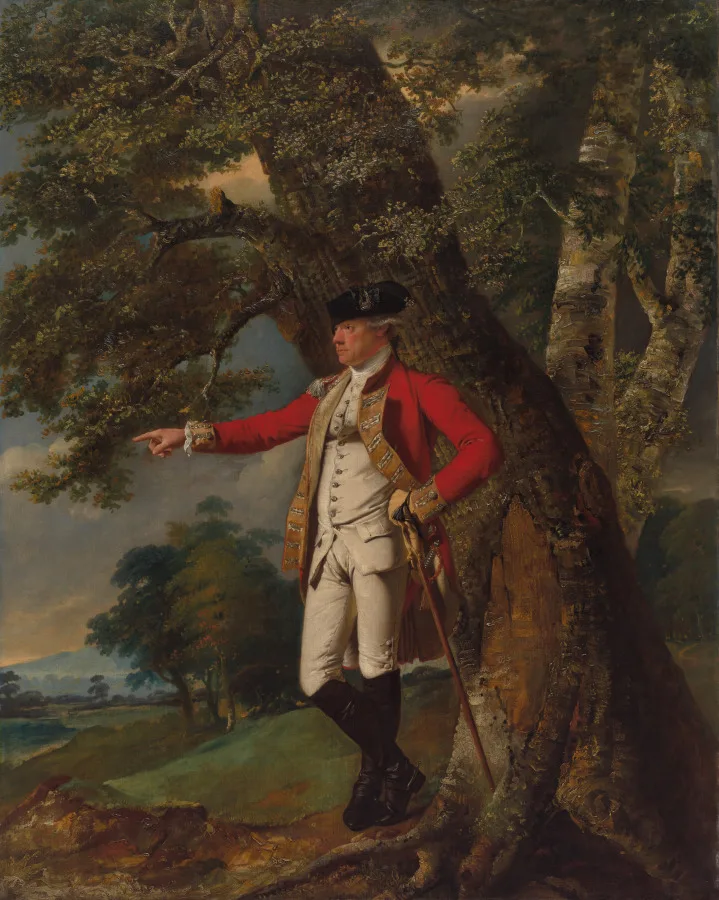
The paintings themselves have not survived as well as the reputation. Reynolds experimented constantly with materials, using bitumen, unstable red lakes, wax and varnish mixtures that never fully dried. Many of his canvases have darkened, cracked into wide fissures or lost the reds from the flesh. Contemporaries joked about it while he was alive, and conservators have been managing the consequences ever since.
- Poses adapted from antique sculpture or from Raphael, Michelangelo and Venetian sources
- Warm golden underpainting that shows through the flesh in his better preserved works
- Children painted with unusual directness compared with his adult sitters
- Costume and background frequently executed by studio assistants
- Wide drying cracks and darkened passages caused by his experimental mediums
- A large body of contemporary mezzotints that spread the compositions across Europe
His rivalry with Gainsborough structured the London market for twenty years. Reynolds was the intellectual, the Academy president, the man with the theory and the classical references. Gainsborough was the natural painter who disliked committees and preferred landscape. Clients chose between them on temperament as much as on price, and the two styles that resulted defined what British portraiture looked like for the rest of the century.
What survives of the Reynolds programme
The Discourses outlived the pictures in influence. William Blake filled his copy with furious marginal notes attacking almost every claim, which tells you how seriously the arguments were taken. Later English painting kept arguing with Reynolds well into the nineteenth century. He died in 1792 and was buried in Saint Paul Cathedral, a burial that would have been unimaginable for a portrait painter fifty years earlier.
Reynolds sold the idea that a portrait could be learned rather than merely accurate, and the British art establishment was built on that sale.
Editorial note, Canvara
For a viewer in a gallery, the practical advice is to check the condition before judging the artist. A Reynolds in good state has a glow in the flesh and a soft, controlled transition from light into shadow. A damaged one looks brown, flat and cracked, and the pose is often the only thing left to admire. The gap between those two experiences is enormous.
Interested in Joshua Reynolds’s work?
Ask a curator for current availability, pricing and how this artist would sit in a collection.
Ask a CuratorBrowse the full Artists Directory.
Or read more in the Journal.
Ask about Joshua Reynolds directly
Availability, current prices, condition, how the work sits in a collection. Leave a number and an editor calls you back within two business days.
This form needs JavaScript. Write to editor@laart.us instead — an editor answers every letter.