
Colonial portraiture
John Singleton Copley
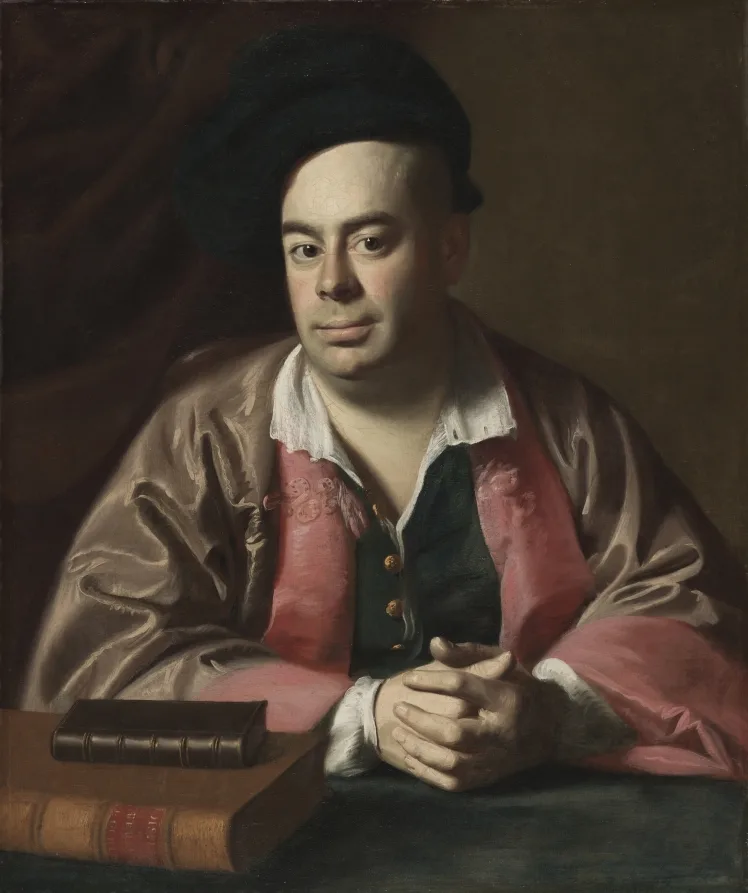
John Singleton Copley learned to paint from prints in colonial Boston and became the finest portraitist working in America. The Cleveland portrait of the silversmith Nathaniel Hurd dates from around 1765.
John Singleton Copley was born in Boston in 1738 and had almost nothing to learn from. There was no academy in the colonies, no collection of old masters and no teacher of consequence. His stepfather Peter Pelham was an engraver, which gave the boy access to mezzotints after English portraits, a stock of materials and the basic mechanics of the trade. Everything else he worked out by looking hard at faces.
By his mid twenties he was the best paid painter in North America. The Boston merchant class wanted portraits and Copley supplied likenesses of a bluntness that English practice had long since smoothed away. His sitters have weight, specific skin, veins in the hands and clothing described down to the reflection of a coat button. The colonial pictures are more literal than anything being painted in London at the same moment.
Learning from prints in colonial Boston
The Cleveland portrait of Nathaniel Hurd is one of the finest of these. Hurd was a Boston silversmith and engraver, a working craftsman rather than a merchant prince, and Copley shows him in a loose gown and soft cap with his engraving manuals on the table. There is no classical pose and no borrowed grandeur. The picture argues that a skilled tradesman is worth a serious portrait, which was a genuinely American proposition in 1765.
In 1766 he sent a picture of a boy with a squirrel to London for exhibition. Reynolds and Benjamin West both saw it, praised the handling and told him that his talent would stall without European training. The advice unsettled him for years. He wrote to West about the impossibility of learning anything more in Boston, where painting was regarded as a useful trade like carpentry and where he had never seen a great picture.
Politics made the decision for him. Copley had married into a family of loyalist merchants, his father in law consigned the tea thrown into Boston harbour, and by 1774 the city was no place for a man with those connections. He sailed for Europe that summer, travelled through Italy, and settled in London in 1775. He never returned to America and never saw most of his early sitters again.
- Colonial portraits built from direct observation with almost no borrowed convention
- Objects rendered with a silversmith level of attention to reflection and texture
- Sitters shown with their tools and trade rather than with classical attributes
- A hard, even light in the American work that softens after he reaches London
- Large history paintings from 1778 onward, exhibited privately for paid admission
- A late career decline as the London market moved on from his manner
London changed the work, and opinion is divided about whether it improved it. The handling became fluent and the compositions more ambitious, and he moved into modern history painting with Watson and the Shark in 1778 and the death of the Earl of Chatham a few years later. Those pictures were shown for paid admission and made him money and reputation. What they lost was the strange, unsoftened clarity of the Boston heads.
Two careers in one working life
The later London years were difficult. Fashion moved, commissions thinned, and he quarrelled with the Royal Academy while his health declined. He died in London in 1815. American collections hold the colonial work, British collections hold most of the histories, and the two halves of the career are rarely seen together, which keeps the argument about him unresolved.
Copley in Boston had no models to copy, and the resulting portraits are the most honest American faces painted before the nineteenth century.
Editorial note, Canvara
For anyone tracking the difference, put a Boston Copley beside a London one. The colonial picture holds every edge in focus and gives you a person you could pick out of a crowd. The London picture is better constructed, more graceful and considerably less memorable, and the trade he made is visible in a single glance.
Interested in John Singleton Copley’s work?
Ask a curator for current availability, pricing and how this artist would sit in a collection.
Ask a CuratorBrowse the full Artists Directory.
Or read more in the Journal.
Ask about John Singleton Copley directly
Availability, current prices, condition, how the work sits in a collection. Leave a number and an editor calls you back within two business days.
This form needs JavaScript. Write to editor@laart.us instead — an editor answers every letter.