
Baroque portraiture
Frans Hals
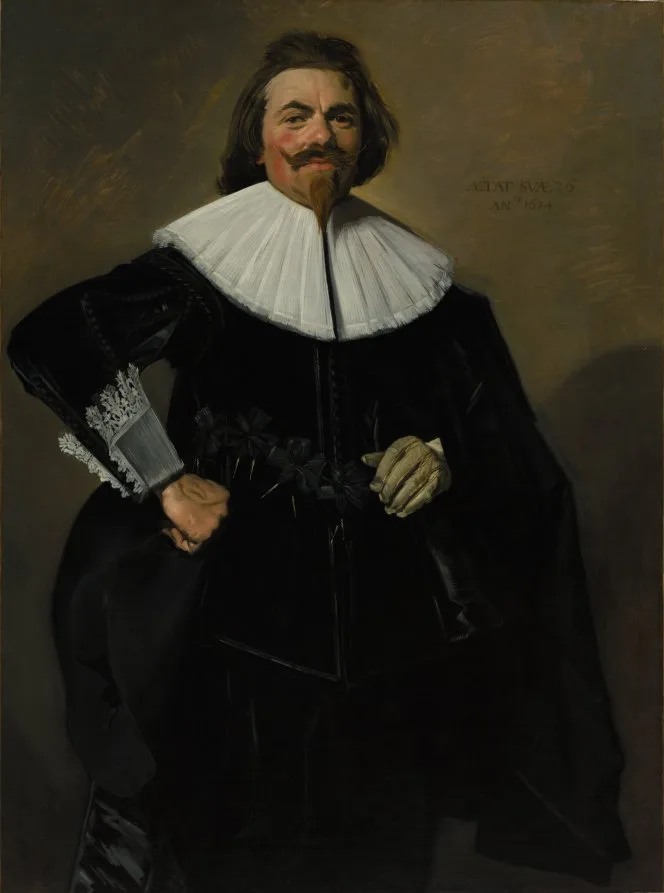
Frans Hals spent his whole career in Haarlem and turned the visible brushstroke into a selling point. The Cleveland portrait of the merchant Tieleman Roosterman, dated 1634, catches that practice at full strength.
Frans Hals is the painter who made speed look like character. He was born in Antwerp around 1582, his family moved north to Haarlem after the city fell to Spanish forces, and he stayed in Haarlem for the rest of a long working life. He joined the local painters guild in 1610 and was still taking commissions in his eighties. Almost nothing survives of him outside portraiture, which is unusual for a Dutch master of that generation.
The Cleveland portrait of Tieleman Roosterman belongs to 1634, when Hals had the Haarlem merchant class arriving at his door in a steady stream. These pictures follow a tight commercial pattern: black clothing, a starched white collar or ruff done in a few decisive strokes, a plain warm ground and a face turned slightly out of the frame. The pattern is what let him work fast. Within it he varied the temperature of the flesh and the angle of the mouth enough that no two sitters look interchangeable.
What the loose handling is actually doing
The strokes are not sketchy by accident and they are not improvised either. Under raking light you can see that the shape of the head is laid in solidly first, and the flourishes go on top of a construction that is already correct. That order of operations is the whole difference between Hals and the painters who imitated his surface without his drawing. A collar in one of his pictures is six or seven marks that describe pleated linen exactly, and no amount of enthusiasm will get you there without the underlying structure.
The civic guard groups are the works that made his local reputation. Haarlem militia companies commissioned large canvases showing officers at a banquet table, and every man paid his share and expected to be recognisable. The genre had produced stiff rows of heads for decades before Hals broke the line up into overlapping conversations, sashes, gestures and glances across the table. Those paintings still hang together in Haarlem and remain the best argument for going there.
His late work goes darker and drier. The Regents and Regentesses of the old men almshouse, painted around 1664, use almost no colour beyond black, white and a few reds, and the handling has become blunt to the point of harshness. Those two canvases are usually read as bitterness about old age and poverty, though the documents supporting that reading are thin. What is certain is that Haarlem granted him a municipal stipend in his final years.
- Black is never one black, so look for the warm and cool variations inside the clothing
- Collars and cuffs carry the visible bravura while the face stays comparatively controlled
- The ground colour is often left uncovered and does real work in the finished picture
- Group portraits are read by following the diagonals rather than the row of heads
- Late works drop nearly all colour and lean on a narrow range of grey and black
- Copies and school pieces repeat the flourish but lose the drawing underneath it
The market forgot him for roughly two centuries. Eighteenth century taste preferred finish, and Hals sat in provincial collections at low prices while smoother Dutch painters went to Paris and London. The revival came through nineteenth century critics and painters, and the French writer Theophile Thore did as much for Hals as he did for Vermeer. After that the prices moved quickly and American collectors bought heavily.
Why painters keep going back to him
Manet, Sargent, Whistler and half the portrait painters of the late nineteenth century studied Hals directly, usually in Haarlem. What they took was permission to leave the mark visible and to let the picture read at a distance instead of at arm length. That lesson passed into modern portraiture so completely that it now looks obvious. It was not obvious in 1634, when a client paying for a likeness expected the labour to be invisible.
Hals is the rare portraitist whose commercial constraints improved the work: a fixed formula and a full order book pushed him toward economy rather than toward display.
Editorial note, Canvara
If you are looking at a Hals for the first time, stand back six or seven paces before going close. From that distance the picture behaves like a photograph of a person mid sentence. Then walk in and watch the whole thing dissolve into separate strokes of loaded paint, none of which describes anything on its own.
Interested in Frans Hals’s work?
Ask a curator for current availability, pricing and how this artist would sit in a collection.
Ask a CuratorBrowse the full Artists Directory.
Or read more in the Journal.
Ask about Frans Hals directly
Availability, current prices, condition, how the work sits in a collection. Leave a number and an editor calls you back within two business days.
This form needs JavaScript. Write to editor@laart.us instead — an editor answers every letter.