
Modernist portraiture
Amedeo Modigliani
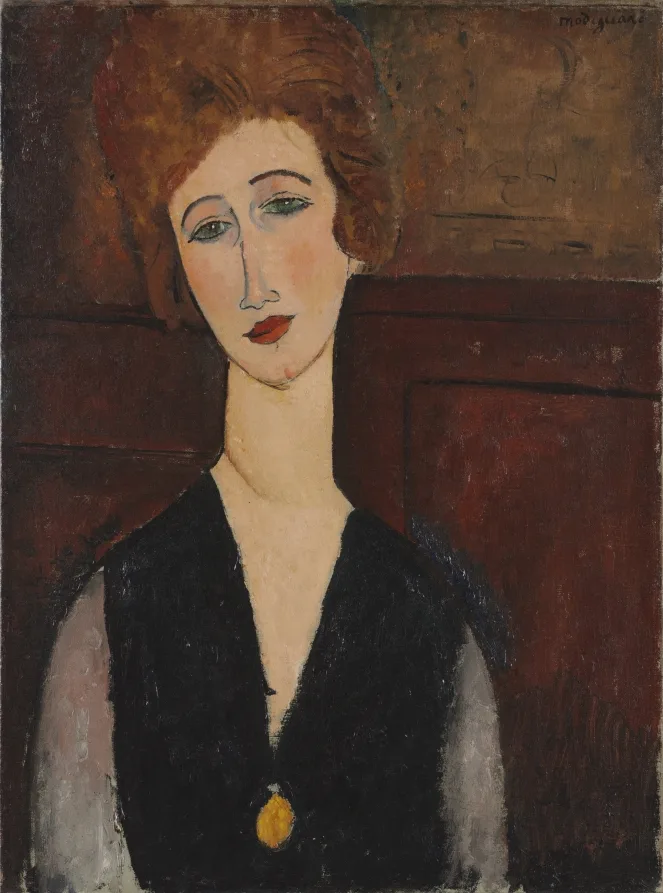
Modigliani spent fourteen years in Paris painting portraits and nudes and almost nothing else. The Cleveland canvas, dated by the museum to around 1917 and 1918, comes from the height of that short mature period.
Amedeo Modigliani was born in Livorno in 1884 into a Sephardic Jewish family whose fortunes had recently collapsed. He was ill from childhood with pleurisy and later typhoid, and the tuberculosis that eventually killed him was diagnosed while he was still a teenager. He studied in Livorno, then in Florence and Venice, looking at Italian painting from Botticelli backward, which is easy to see in the finished work.
He arrived in Paris in 1906 and spent the rest of his life there, first in Montmartre and then in Montparnasse. The city was full of painters doing radical things with form, and he watched all of it carefully while joining none of the movements. He exhibited with nobody in particular, signed no manifestos and produced no theory. What he did instead was narrow his subject matter until almost nothing remained except the human head and figure.
The sculpture years and what they left behind
Around 1909 he met Constantin Brancusi and turned to carving. For roughly four years stone was his main occupation, and he produced a series of elongated limestone heads, several of which were shown at the Salon d'Automne in 1912. He worked directly into the block, taking African and Cycladic sculpture as a starting point rather than the classical tradition he had been trained on.
The carving stopped by about 1914. The stone dust was intolerable for damaged lungs, materials became impossible to get during the war, and money was short. He went back to painting, and everything the sculpture had taught him came with it: the column of the neck, the oval simplified into a mask, the nose reduced to a ridge, the whole head treated as something carved rather than observed.
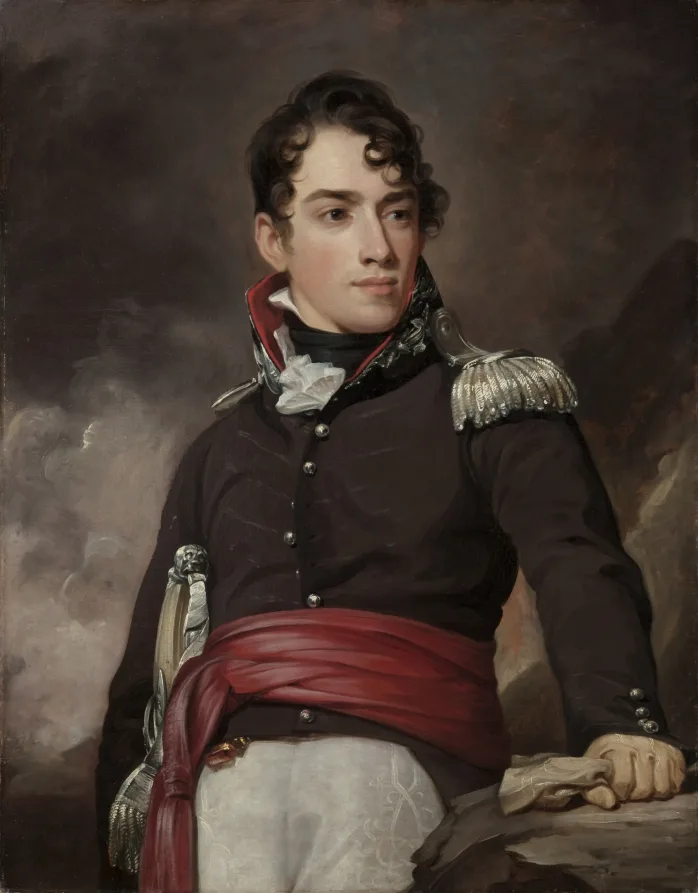
The mature style arrived quickly and did not change much afterward. A single figure fills the canvas against a plain wall or a corner of a room, the pose is frontal or slightly turned, and the drawing runs in long unbroken contours. Eyes are frequently painted as flat blue or grey ovals with no pupil at all. The effect is disconcerting at first and then becomes the most memorable thing about the pictures.
- Long unbroken contour lines that describe the whole figure in a few strokes
- Necks and hands stretched well past anatomical proportion
- Eyes often left as blank ovals without pupils or focus
- Plain interior backgrounds with a corner, a chair back or a door frame for structure
- Warm ochre and rose flesh set against greys, blues and dull greens
- Almost no subjects other than portraits and the nudes of 1916 and 1917
His only solo exhibition opened at the gallery of Berthe Weill in December 1917 and ran into immediate trouble. A nude in the window drew a crowd and the police ordered the works removed on the day the show opened. He had a dealer in Leopold Zborowski who supported him with materials, models and small advances, and who kept the practice going through the war years when there was very little market for anything.
Why the market keeps producing fakes
He died in Paris in January 1920 of tubercular meningitis, at thirty five. Prices for his work climbed steadily through the twentieth century and are now among the highest for any modern painter. That combination of high value, a short career and a style that looks deceptively simple to copy has made Modigliani one of the most heavily forged artists in the market. An exhibition in Genoa closed early in 2017 after Italian authorities seized works on suspicion that they were not genuine.
Modigliani is easy to imitate and almost impossible to reproduce: the contour looks simple until you try to draw it, and every forgery fails at exactly that line.
Editorial note, Canvara
Anyone approaching this material should treat provenance as the first question and connoisseurship as the second. The catalogue history of his work is contested, competing catalogues raisonnes disagree, and estate paperwork from the 1920s is thin. For looking rather than buying, the advice is simpler: follow the outline of one figure from shoulder to jaw and notice how few decisions the drawing actually contains.
Interested in Amedeo Modigliani’s work?
Ask a curator for current availability, pricing and how this artist would sit in a collection.
Ask a CuratorBrowse the full Artists Directory.
Or read more in the Journal.
Ask about Amedeo Modigliani directly
Availability, current prices, condition, how the work sits in a collection. Leave a number and an editor calls you back within two business days.
This form needs JavaScript. Write to editor@laart.us instead — an editor answers every letter.